Tender Offer Windfall? How to Time a Peninsula Home Purchase for Tax Efficiency
If you've been part of a tender offer at OpenAI, Anthropic, or another Bay Area AI company in the last year, you already know the number on your account statement doesn't match the number you actually get to keep. Anthropic's April 2026 tender priced shares at a $350 billion pre-money valuation. OpenAI's most recent secondary, ahead of its confidential IPO filing in June, put employee shares in the $400–500 billion valuation range. Real money moved. And now the tax bill is the thing standing between that number and a down payment.
We work with enough Peninsula buyers coming out of these liquidity events to know the questions are almost always the same. Here's what we'd want you to know before you start touring homes in Burlingame, Hillsborough, or San Mateo.
Does your stock qualify for QSBS treatment?
Qualified Small Business Stock, or QSBS, can exclude a significant portion of your gain from federal capital gains tax if the shares meet specific holding-period and company-size requirements at the time they were issued. This is the single biggest lever in this conversation, and it's worth a conversation with your tax advisor before you decide how much of your windfall to sell versus hold. Whether your specific grant qualifies depends on when you were issued the shares and the company's asset size at that time — not something we can tell you, but something worth confirming before you plan a purchase around the proceeds.
AMT and the ISO trap
If any portion of your equity came in the form of incentive stock options rather than RSUs, exercising those options can trigger the Alternative Minimum Tax even if you haven't sold a single share. We've seen buyers get this backwards — assuming their liquidity event and their tax event happen in the same calendar year, when in fact the AMT hit from an earlier exercise can land in a completely different year than the cash from the sale. This matters for a home purchase because it changes how much of your windfall is actually available to deploy, and when.
Sequencing your sale across tax years
If your tender or secondary sale gives you any flexibility in timing — some do, some don't — spreading proceeds across two tax years instead of realizing everything at once can keep you out of the top marginal bracket on a meaningful portion of the gain. This is a conversation for your CPA, but it's directly relevant to us because it also affects when you're ready to close on a home. We've structured purchase timelines around exactly this kind of sequencing for other clients coming out of Anthropic and OpenAI liquidity events.
Where the home purchase itself fits in
Once you know what you're actually working with after tax, the real estate decision starts to look different depending on structure:
Buying now, in a calendar year when you've realized a large gain, means your down payment is coming out of after-tax windfall cash — straightforward, but you're deploying capital in the same year you're already paying your largest tax bill.
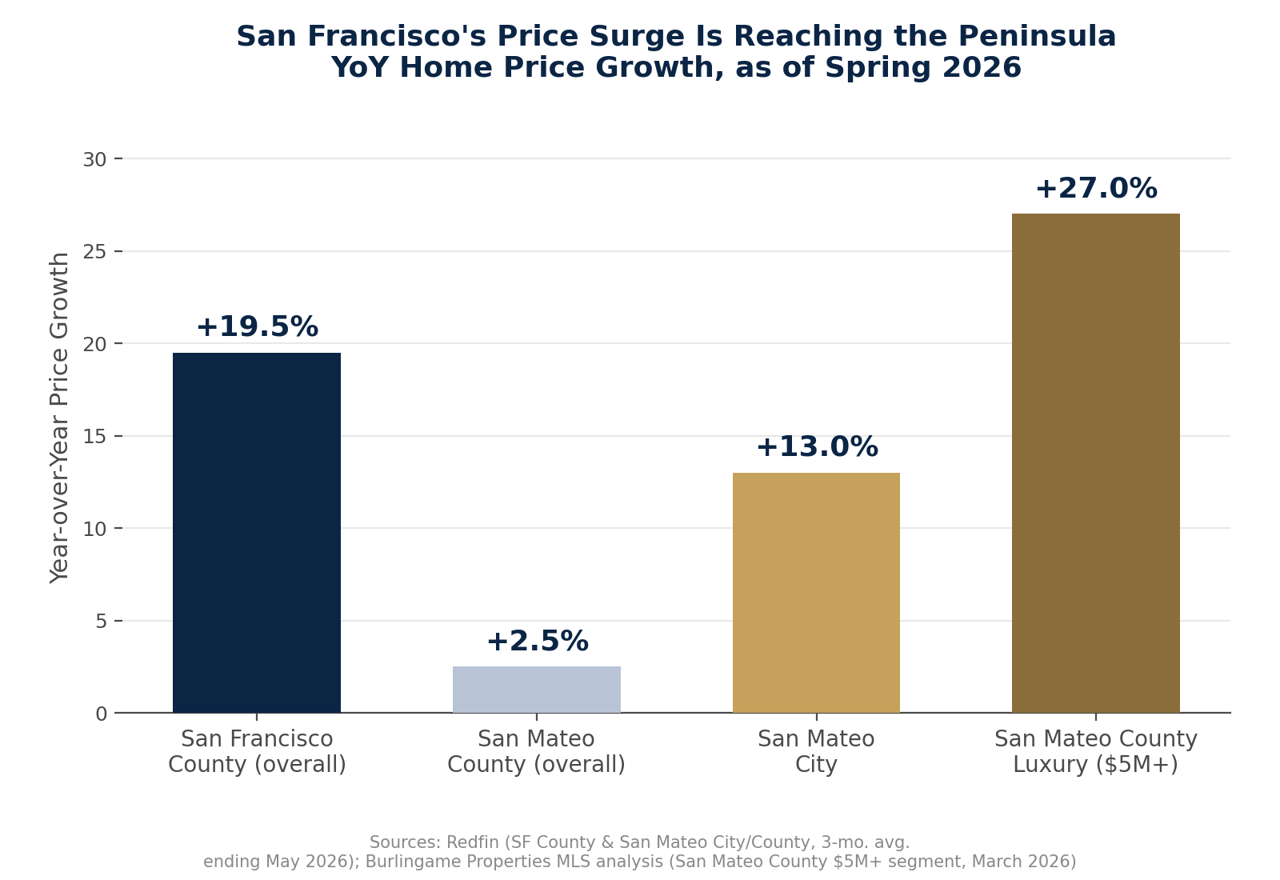
Waiting until the following year lets the dust settle on your tax liability first, but means sitting in a market that's shifted meaningfully in the last few months. Belmont inventory nearly tripled this spring, and the share of homes closing over asking dropped from roughly 79% to 50% — which actually works in a patient buyer's favor right now.
Using a securities-backed line of credit against unsold shares instead of a straight cash-out lets you defer the tax event on additional shares entirely while still funding a purchase today. We cover that structure in more detail in a companion post.
There's also a longer-term piece worth having on your radar even if it feels early: the primary residence capital gains exclusion. If you buy now and it becomes your primary home, you and a spouse can eventually exclude up to $500,000 in gain when you sell, provided you meet the ownership and use requirements. For someone who just realized a large one-time gain from equity, building future tax-advantaged gain into a home purchase is worth factoring into the decision of what to buy and where.
The honest answer
There's no single right sequence here — it depends on your specific grant type, your other income that year, and how much of your equity is still unsold and available to leverage. What we can tell you is that the buyers we've worked with who came out ahead were the ones who had this conversation with their CPA and with us before they started touring homes, not after they found the one they wanted.
If you're sitting on proceeds from a recent tender offer, or expecting to be in the next one, we're happy to walk through how the timing could work for a purchase in San Mateo County. Reach out to Casey Sternsmith at [email protected] or 650-678-5455.